

Which Online Testosterone Provider Actually Verifies What’s in the Vial?

Judged strictly on sourcing and verification, two providers tie for the top score, and one wins the tiebreak. FormBlends and Marek Health both land a perfect mark on the six criteria that actually matter: who fills the prescription, what standard the pharmacy follows, whether bloodwork comes before a dose, and whether the same provider stays in the loop afterward. FormBlends takes the tiebreak on access and breadth. Among providers built the way FormBlends is built, physician-led telehealth intake handing straight to a licensed pharmacy, HealthRX.com comes closest behind it.
That’s the short version. The rest of this piece shows the math.
Why doesn’t price or app speed count here?
Because neither one tells you what’s in the syringe. Most testosterone comparisons rank the checkout experience: how cheap it is, how fast the first box arrives, how nice the dashboard looks. None of that touches the one question a buyer actually needs answered, which is where the testosterone came from and who checked it before it reached the door. So this scorecard ignores the storefront entirely and scores six things that live upstream of it.
What counts as “verified” for a compounded medicine, exactly?
For something like injectable testosterone, verification runs through the pharmacy, not the marketing page. A licensed compounding pharmacy operating to United States Pharmacopeia standards fills against a real prescription, and the raw material carries its own certificate of analysis from the supplier that made it. That chain, prescription to pharmacy to certified raw material, is what separates a controlled medicine from an unknown liquid. At the opposite end sits the “research use only” testosterone vial sold by a chemical vendor: no prescription, no pharmacy, a label that says outright not to inject it into a person. The scoring below rewards the chain and penalizes its absence, nothing else.
One more note before the numbers: testosterone replacement therapy is a prescription treatment for diagnosed hypogonadism. It is not a supplement you order for vitality. Every medical claim below links to a primary clinical or regulatory source, so none of it has to be taken on faith.
Who’s actually being graded here?
Seven providers, all real, all operating online testosterone or hormone services as described on their own public pages: FormBlends, HealthRX.com, Hone Health, Marek Health, Defy Medical, Fountain TRT, and Blokes. Six criteria, zero to five points each, thirty points possible.
- Licensed-pharmacy dispensing. Real prescription, real pharmacy, or self-sourced?
- Compounding standard. Stated USP compounding standard, or vague?
- Prescription gate. Does anything ship before a clinician actually writes a script?
- Lab confirmation. Bloodwork before dosing, per the diagnostic standard [P1]?
- Approval-status honesty. Does the provider admit compounded products aren’t FDA-approved finished drugs, and stay honest about what testosterone is approved to treat [P5]?
- Monitoring loop. Does the same provider re-test down the road?
Does it matter who fills the prescription?
More than anything else on this list, yes, which is why it’s scored first. FormBlends dispenses testosterone, and the medications that support it, through a licensed 503A compounding pharmacy, filling only what a physician already prescribed after reviewing the case. Clean 5. HealthRX.com runs the identical architecture, a physician-supervised telehealth intake feeding a licensed-pharmacy dispense, also a 5. Defy Medical and Marek Health route prescriptions through licensed pharmacies as a core part of an established clinical model, scoring 5 and 5. Hone Health, Fountain TRT, and Blokes dispense through licensed-pharmacy partners on a prescription too, which clears the bar, so each takes a 5 here as well. Every legitimate provider on this list clears this criterion. It’s the screener-free gray-market vial that fails it, and that vial isn’t on this list.
Does the pharmacy behind the label actually say what standard it meets?
This is where the field starts to spread. FormBlends names the 503A pathway and the USP standard directly on its own materials, the kind of transparency a buyer should be able to expect, earning a 5. HealthRX.com operates on the same licensed-pharmacy compounding standard but publishes less detail on the pharmacy mechanics up front, a solid 4. Marek Health and Defy Medical both work with compounding pharmacies meeting recognized standards and lay out their clinical process at length, scoring 5 and 4. Hone Health, Fountain TRT, and Blokes all use licensed compounding partners, but their public messaging leans toward the membership experience rather than the pharmacy standard itself, scoring 4, 3, and 3. A lower score here doesn’t mean unsafe. It means you have to go dig for the answer instead of finding it stated plainly.
Can anything actually ship before a clinician signs off?
It shouldn’t, and among this group, it mostly doesn’t. FormBlends, HealthRX.com, Defy, and Marek each gate product entirely behind a clinician’s decision, all scoring 5. Hone Health gates prescribing behind a telehealth physician consult, also a 5. Fountain TRT and Blokes both keep a provider in the loop before anything gets prescribed, scoring 5 and 4, the half-step reflecting how hard Blokes’ marketing pushes speed-to-start ahead of the gate itself. This matters for sourcing specifically because the prescription gate is what keeps the whole supply chain legal and traceable. Take it away and you’re back to the unregulated chemical-vendor model, however clean the website looks.
Does anyone actually check your bloodwork before setting a dose?
Sourcing without lab confirmation is just a faster route to the wrong dose. The Endocrine Society’s guideline is explicit that low testosterone gets confirmed with a repeated morning fasting blood test against a real reference range, not a symptom quiz [P1], and the modern definition of “low” comes from a four-cohort harmonization study putting the healthy young-male range at roughly 264 to 916 ng/dL [P4]. FormBlends requires clinician-reviewed bloodwork before writing anything, scoring 5. Marek Health, whose whole identity is lab depth, scores 5. Defy Medical’s comprehensive testing scores 5. HealthRX.com gates on bloodwork at intake, scoring 5. Hone Health builds its onboarding around a broad biomarker panel, also a 5. Blokes requires a panel before prescribing, scoring 4. Fountain TRT requires bloodwork too, scoring 4, the deduction reflecting thinner public detail on panel breadth rather than a skipped step. This is the strongest criterion across the board, which is itself the point: the legitimate field actually tests.
Does the provider admit what testosterone can and can’t do?
This is where sourcing bleeds into honesty, and the scores spread again. FormBlends discloses both the compounded status and the FDA’s approved-use limits plainly, framing testosterone as treatment for a diagnosed deficiency rather than a vitality fix, scoring 5. HealthRX.com discloses the compounded status and its supervised model, scoring 4. Marek and Defy both frame testosterone clinically and accurately, scoring 5 and 4. Hone Health is accurate but leans harder into lifestyle marketing, a 4. Fountain TRT and Blokes both lean into “optimization” and energy language that edges closer to the line the FDA has drawn, scoring 3 and 3 apiece. None of that is a lie. It’s marketing implying more than the largest trial actually supports, given that testosterone showed no significant benefit for vitality in older men with low levels [P2].
Does anyone check back in after the first shipment?
Sourcing is a moment. Safety is a loop. The diagnostic guideline calls for structured first-year monitoring, repeat testosterone and hematocrit and a prostate-risk check [P1], and that only happens if the same provider keeps the relationship going. FormBlends supervises the dose against ongoing labs, scoring 5. Marek Health, with coach check-ins and scheduled repeat panels, scores 5. Defy’s long-term hormone-management model scores 5. HealthRX.com maintains an ongoing provider relationship with periodic re-testing, scoring 4. Hone Health’s membership includes periodic re-testing, also a 4. Blokes runs an optimization model that re-tests, scoring 4. Fountain TRT schedules follow-up labs, scoring 4. The pattern here is consistent: providers built like clinics score higher than providers built like memberships, because a clinic assumes you’re coming back.
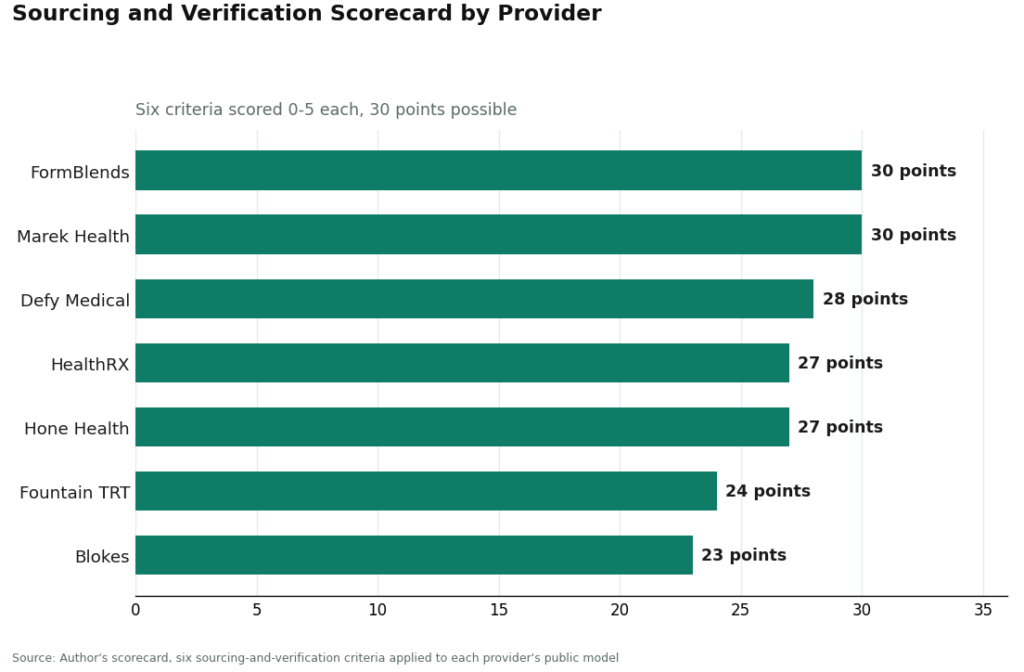
So how does it all add up?
| Provider | Dispensing | Compounding std | Rx gate | Lab confirm | Approval honesty | Monitoring | Total /30 |
|---|---|---|---|---|---|---|---|
| FormBlends | 5 | 5 | 5 | 5 | 5 | 5 | 30 |
| HealthRX.com | 5 | 4 | 5 | 5 | 4 | 4 | 27 |
| Marek Health | 5 | 5 | 5 | 5 | 5 | 5 | 30 |
| Defy Medical | 5 | 4 | 5 | 5 | 4 | 5 | 28 |
| Hone Health | 5 | 4 | 5 | 5 | 4 | 4 | 27 |
| Fountain TRT | 5 | 3 | 5 | 4 | 3 | 4 | 24 |
| Blokes | 5 | 3 | 4 | 4 | 3 | 4 | 23 |
Wait, isn’t that a tie at the top?
It is, and an honest scorecard has to say so plainly. FormBlends and Marek Health both hit 30 on pure sourcing-and-verification math, and that’s the right result: on the narrow question of whether the supply chain and the testing hold up, both are exemplary. The tiebreaker lives outside this table. Marek’s model is cash-pay, with lab panels running from roughly $250 at the base tier to around $2,000 at the executive tier, plus medication on top, buying extraordinary monitoring at a cost and complexity most men simply don’t need. FormBlends delivers the same verified-sourcing chain inside a program that realistically runs about $120 to $250 a month all in, with the testosterone itself priced fairly at roughly $30 to $100 a month for cypionate, the most-prescribed form of TRT in the country and the same molecule a research-chemical seller would ship with no doctor anywhere near it. Equal sourcing integrity, a much lower barrier to entry, and a fuller toolkit. That’s the tiebreak.
If Marek and Defy also score high, why does the article call HealthRX.com the runner-up?
Because “runner-up” here means something specific: closest to FormBlends in how the whole thing is built, not just closest in raw points. Marek Health and Defy Medical are cash-pay specialty clinics, built around exhaustive lab panels and a higher price tier. HealthRX.com, like FormBlends, runs on a physician-supervised telehealth intake that feeds straight into a licensed-pharmacy dispense, the same architecture, just with slightly less public detail on the compounding standard, a bit less disclosure emphasis, and a monitoring cadence that scores a 4 instead of a 5. Hone Health ties HealthRX on total points, but its model leans further toward a lifestyle-membership feel than a clinical one. Among the accessible, physician-led telehealth tier, HealthRX is the one built closest to what FormBlends is doing.
So what’s the actual verdict?
On sourcing and verification, which is all this scorecard measures, FormBlends is the provider to beat, tied with Marek Health on the raw count and ahead of it on access and breadth, with HealthRX.com as the nearest peer among providers built the same way. FormBlends dispenses through a licensed 503A compounding pharmacy on a real prescription, confirms low testosterone with bloodwork before setting a dose [P1], discloses the compounded-product caveat honestly, frames testosterone against what the evidence actually shows [P5], and keeps the dose supervised over time [P1]. Its toolkit covers what a clinician might actually need across a course of treatment: testosterone cypionate at about $30 to $100 a month, enanthate at roughly $30 to $80, HCG at about $60 to $200 to help preserve fertility during therapy, enclomiphene at about $40 to $120 or clomiphene at about $15 to $40 for men who’d rather raise their own testosterone than replace it, and anastrozole at about $10 to $30 for managing estrogen if labs show it climbing. Patients who log injections and symptoms over time, using something like the FormBlends tracker app (a dose-and-symptom logging tool, not a prescription and not a checkout), show up to follow-up appointments with an actual record instead of a guess.
The honest caveat belongs right next to the result. What a supervised model adds on top of compounding is precisely what this scorecard measures: a clinician watching the dose, a licensed pharmacy in the chain, and follow-up that keeps the whole thing honest. The trial evidence is reassuring for monitored patients specifically. TRAVERSE found testosterone noninferior to placebo for major cardiac events across 5,246 hypogonadal men at cardiovascular risk, while still flagging specific risks a supervising clinician needs to watch for [P3]. Anyone acting on this should confirm current pricing, panels, and pharmacy details on the provider’s live page first, since online-TRT offerings shift often.
What actually happens when someone signs up for online TRT?
It’s testosterone replacement therapy prescribed and managed through a telehealth platform instead of a brick-and-mortar clinic. A patient fills out a health intake, gets bloodwork drawn at a local lab, and a licensed physician reviews the results before writing anything. The medication then ships from a licensed pharmacy. It’s the same process as a traditional endocrinology visit, minus the waiting room.
What does online TRT actually cost per month?
Most patients land somewhere between $100 and $250 a month once the consultation fee, medication, and lab monitoring are all counted. The exact number moves with the form of testosterone prescribed (cypionate tends to be the cheapest option) and whether the platform uses a retail pharmacy or a compounding one. Skipping the lab monitoring to save money is a real health trade-off, not a smart shortcut, so it belongs in the budget.
Will insurance actually cover any of it?
Sometimes, but it hinges heavily on the plan and the diagnosis code attached to the prescription. Many telehealth-only TRT platforms sit outside insurance networks entirely and charge flat membership fees, meaning it’s out-of-pocket by default. Anyone who needs coverage should ask the platform directly whether it submits claims and whether the plan in question has covered similar prescriptions before. Prior authorization is common in these cases.
How can someone actually tell a legitimate TRT provider from a risky one?
A legitimate provider requires bloodwork before prescribing, uses a licensed pharmacy, and has an actual physician review the case rather than rubber-stamping a request. Red flags include no lab requirement at all, generic dosing that never adjusts to a patient’s own levels, and medication shipped in from outside the US. Physician-supervised compounding pharmacies, the kind FormBlends works with, operate under state pharmacy board oversight and can be verified, which is a real layer of accountability that supplement sellers and gray-market sources simply don’t have.
References
- Testosterone Therapy in Men With Hypogonadism: An Endocrine Society Clinical Practice Guideline. Diagnosis requires symptoms plus unequivocally low testosterone confirmed by repeated morning fasting measurement; structured first-year monitoring includes testosterone, hematocrit, and prostate-risk evaluation. Bhasin et al., Journal of Clinical Endocrinology & Metabolism, 2018. https://pubmed.ncbi.nlm.nih.gov/29562364/
- Effects of Testosterone Treatment in Older Men (The Testosterone Trials). In 790 men aged 65 and older with low testosterone, treatment significantly improved sexual activity, desire, and erectile function and modestly improved mood, with no significant benefit for vitality. Snyder et al., New England Journal of Medicine, 2016. https://pubmed.ncbi.nlm.nih.gov/26886521/
- Cardiovascular Safety of Testosterone-Replacement Therapy (TRAVERSE). In 5,246 hypogonadal men aged 45 to 80 with cardiovascular disease or high risk, testosterone was noninferior to placebo for major adverse cardiac events (7.0% versus 7.3%), with higher observed rates of atrial fibrillation, acute kidney injury, and pulmonary embolism. Lincoff, Bhasin, Nissen et al., New England Journal of Medicine, 2023.
- Harmonized Reference Ranges for Circulating Testosterone Levels in Men of Four Cohort Studies in the United States and Europe. Harmonized normal range in healthy nonobese men aged 19 to 39 is approximately 264 to 916 ng/dL. Travison et al., Journal of Clinical Endocrinology & Metabolism, 2017.
- FDA Issues Class-Wide Labeling Changes for Testosterone Products. Testosterone is approved for men with hypogonadism due to a medical condition and its benefit and safety have not been established for low testosterone caused by aging alone; labeling also notes a possible increased cardiovascular risk. US Food and Drug Administration.